Education
STEAM activities with a school hydroponic garden: 6 ideas for the classroom
A hydroponic garden at school is much more than plants in a classroom: it is a living lab where science, technology, engineering, art and maths come together in one project. These six activities are designed to fit into the timetable with simple materials and clear assessment.
If your school does not have a garden yet, start with our guide to the school hydroponic garden, which covers requirements, placement and maintenance.
1. Growth journal (Science and Maths)
Age: 8 to 12.
Goal: observe a plant’s life cycle and record data regularly.
Materials: ruler, notebook or tablet, school camera.
Steps: each group adopts a plant, measures its height and counts its leaves twice a week, always photographing from the same angle. At the end of the cycle, they build a growth chart.
Assessment: consistency of the log, quality of the chart and a written conclusion about what they observed.
2. pH and nutrient lab (Science)
Age: 10 to 16.
Goal: understand what a plant needs to grow without soil and what pH means.
Materials: pH strips or meter, cups, tank water and tap water, gloves.
Steps: compare the pH of tap water with the nutrient solution, record the values and relate them to the recommended range for the crop. The teacher or maintenance team handles the concentrated solution.
Assessment: short lab report with hypothesis, measurement and explanation of the result.
3. Engineering the tower (Technology and Engineering)
Age: 11 to 16.
Goal: understand how a hydroponic system works: pump, water circulation, timer and lighting.
Materials: the tower itself, paper for diagrams and, optionally, basic electronics kits.
Steps: watch the system running, draw the path of water and energy, and work out what would happen if each component failed. Older students can design a simple water-level alarm.
Assessment: accurate diagram and an oral pitch for a proposed improvement.

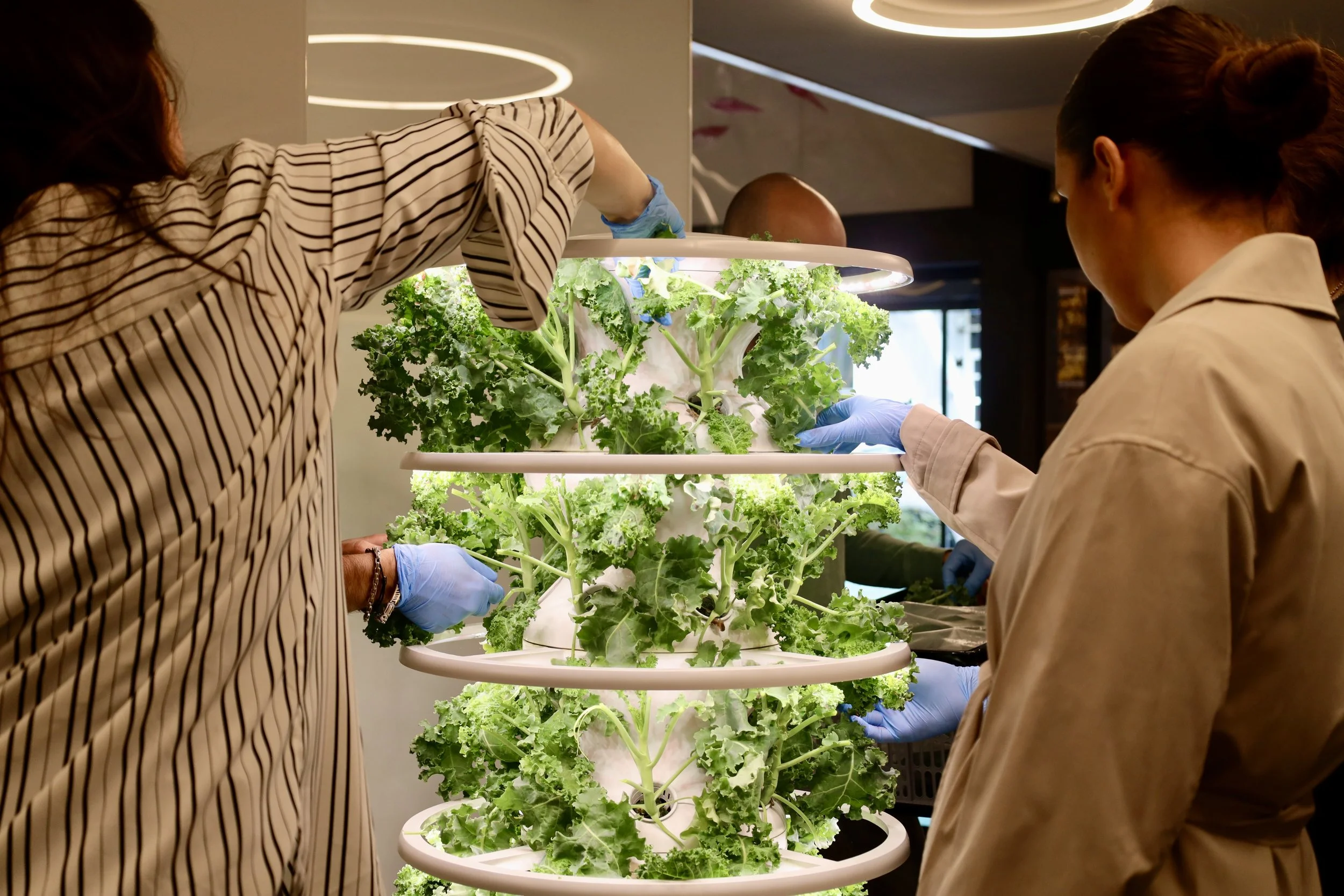
Look, smell and touch: the garden turns science lessons into first-hand experience.
4. Botanical illustration (Art)
Age: 6 to 14.
Goal: build close observation skills through drawing.
Materials: graphite and coloured pencils, watercolours, magnifying glasses.
Steps: choose a plant, study the shape of its leaves, veins and visible roots, and draw it at two different points in its cycle. The drawings can become an exhibition next to the garden.
Assessment: accuracy of observation, use of colour and correct labelling of plant parts.
5. Harvest budget (Maths)
Age: 10 to 14.
Goal: apply measurement, ratios and calculation to a real case.
Materials: kitchen scale, calculator, supermarket leaflets.
Steps: weigh the harvest for each crop, work out how many portions it yields and compare it with the cost of buying the same amount. Close with a discussion on why the garden’s value is not only financial.
Assessment: accuracy of calculations and quality of reasoning in the discussion.
6. Harvest fair (capstone project)
Age: all stages, with roles adapted to each.
Goal: share what was learned with the school community.
Materials: the harvest, growth journals, illustrations and diagrams from the previous activities.
Steps: students run stands where they explain the system, present data and offer a simple tasting, such as a salad or basil pesto, following the school’s hygiene and allergy rules.
Assessment: rubric covering oral communication, rigour of the data presented and teamwork.
How to fit the activities into the school year
A hydroponic tower allows several growing cycles per school year, so activities can be repeated with different crops. A good sequence is to start with the growth journal and illustration, bring in pH and engineering mid-cycle, and finish with the harvest budget and fair. Our guide on what to grow in an indoor hydroponic garden lists easy crops to start with.
Safety and hygiene, kept simple
Wear gloves when handling plants and roots, wash hands before and after, keep concentrated nutrients in adult hands only and wash the harvest before eating it. With an external maintenance service, the technical side is covered and teachers can focus on learning. To understand the system better, see our guide to indoor hydroponics: light, water and nutrients.
Frequently asked questions
Do teachers need prior training?
It is not essential. A kick-off session and well-prepared activity sheets are enough to get started safely.
What happens to the garden during holidays?
The growing calendar is planned so harvests do not fall in school breaks and, if the service includes maintenance, the system stays looked after.
Does it work for project-based learning?
Yes. The garden offers a real challenge with data, deadlines and a final product to present, which are the ingredients of a good project.
Want to bring these activities to your school? Explore our education programme or tell us about your project and we will design the garden and its calendar together.
No garden yet? Start with our guide to setting up a school garden.